
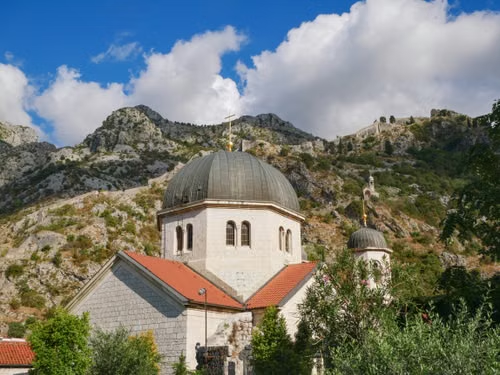
DIRECT ANSWER: For a first trip, focus a 9- to 11-day stretch on a combination of Croatia, Bosnia and Herzegovina, and Montenegro, and you’ll manage to see Dubrovnik, Mostar, and Kotor without it all turning to a checklist. Add Slovenia on the front if spending a day at the Plitvice Lakes matters to you, or Albania towards the back if you’ve got 12 to 14 days. What a guide earns their keep on, across any of these combinations, is the border paperwork, the almost-universal currency swaps at nearly every crossing, and knowing which town deserves a full day, not a photo stop.
“The Balkans” sounds like one trip, but it’s really several: most first-time planners consult a map, see how far apart everything is, and design a “tour” attempting to visit six in ten. It rarely survives Day Four.
Here’s what actually goes well together, how long each combination genuinely needs, and what a private driver or guide is actually doing for you at every border along the way.
Which Countries Actually Sit Well Together?
Mostly a geography question, not a preference. Croatia, Bosnia and Herzegovina, Montenegro, and Albania run in a rough line down the Adriatic so that a road trip through them feels natural, not forced. Slovenia sits north of Croatia and fits in easily, but North Macedonia and Serbia are further inland, and getting to either involves real driving hours, not a quick detour off the coast.
Croatia and Montenegro. The most common pairing, and for good reason; the Old Town of Dubrovnik on one end and the Bay of Kotor on the other connect with a coastal drive regularly named as the best leg of the trip. If borders and logistics make you nervous, this is where to start. Our Croatia tours and Montenegro tours pages detail each leg.
Croatia, Bosnia and Herzegovina, and Montenegro. What most guides mean when they’re referring to “the Balkan itinerary”, but is a bit misbegotten because it inserts Mostar’s Ottoman Old Town and Stari Most bridge between the two coastal stops, and offers the widest variety of history in the fewest additional days. Our Bosnia and Herzegovina tours page covers how Mostar and Sarajevo fit in.
Slovenia and Croatia. Skips the coast entirely for the Lake Bled, Ljubljana, and Plitvice Lakes before heading south to Dubrovnik or Split. Both countries are inside the EU and Schengen, so the crossing between them is a road sign.
The full six-country route. Slovenia down through North Macedonia in one continuous loop. It’s the most complete version of the region you can build, but is really a trip for return visitors with three weeks or more, not a first two-week vacation.
Squeezing it in to ten days makes every stop a drive-by.
So How Many Days Does This Actually Take?
More than most people budget. Ten-day stretches are more of a floor than a recommendation once you’re combining three countries, not compressing everything into.
| Combination | Countries | Recommended duration | Best for |
|---|---|---|---|
| Croatia + Montenegro | 2 | 7 to 8 days | First Balkan trip, simplest logistics |
| Slovenia + Croatia | 2 | 8 to 9 days | Plitvice and the Adriatic, no extra border stress |
| Croatia + Bosnia and Herzegovina + Montenegro | 3 | 9 to 11 days | History plus coast, the classic route |
| Add Albania | 4 | 12 to 14 days | Two full weeks, coast keeps going south |
| Full six-country route | 6 | 16 to 18+ days | Return visitors, no rush |
KEY TAKEAWAY: Two or three countries across 8 to 11 days make up for a genuinely satisfying first trip. Every country beyond that adds two to three days minimum, once real driving time and at least one full day per major stop are accounted for, not the half-day a fixed group tour allots.
What Is a Local Guide Actually Doing on a Route Like This?
Not mostly narrating history. On a multi-country Balkan route, the value shines through in the logistics that trip up travelers who’ve never crossed this many border in one.
Border paperwork, and where the EU’s new system actually applies. The EU’s Entry/Exit System goes fully live across Schengen borders on April 10, 2026, and Croatia and Slovenia are both in Schengen while Bosnia, Montenegro, Albania, and North Macedonia are not. Several other Schengen countries received extra time to phase in a full biometric check, but the grace period expired in early September 2026, and Croatia was never on that delayed list to begin with. So your first entry into Croatia or Slovenia already involves a fingerprint and photo scan for non-EU passport holders, which is a few minutes’ difference, not hours, and changes nothing at the non-Schengen crossings between Bosnia, Montenegro, and Albania. A guide who runs this route regularly knows which single checkpoint this actually slows down.
Currency, which changes nearly every time you cross a line on the map. Croatia and Slovenia use the Euro. So does Montenegro, despite not being an EU member; cross into Bosnia and Herzegovina, and it’s the Convertible Mark. Albania uses the Lek, and North Macedonia uses the Denar. Someone who drives this route often enough knows which stops still want small cash in the local currency and which take cards everywhere, so you’re not hunting for an ATM in a town you’re going to pass through.
Which stop deserves a full day, and which one doesn’t. Mostar sits almost exactly between Dubrovnik and Kotor, making it tempting to treat as a two-hour photo stop at the bridge. Don’t. The old bazaar and the countryside around it earn a full day, and cutting Mostar short is the single most common regret travelers report after this route. Kotor is given the same treatment in reverse: a lot itineraries give it one overnight, when the old town, the fortress climb above the bay, and a boat out on the water genuinely fill two days without repeating themselves.
One driver, start to finish. Handing off between separate local guides at every border adds coordination overhead, and you re-live the “getting oriented” phase at each new stop. A single driver who knows the whole route keeps the trip feeling like one continuous journey, as opposed to three bookings stitched together, and they’re the one who knows that crossing on a Tuesday morning moves faster than a Saturday afternoon in August.
KEY TAKEAWAY: The passport check at the Croatia or Slovenia border now takes a few extra minutes, due to the EU’s system. The currency switch at nearly every other border is the bigger everyday hassle, and a guide who works the route plans around both.
Want a route built around the countries and days that make sense for your trip? Start planning your private Balkan tour and we’ll handle the border crossings, currency stops, and site timing across whichever countries you combine.
Where Do Albania and North Macedonia Actually Fit?
Both are worth the trip. Neither is a quick detour.
Albania’s Adriatic coast to the south of Montenegro, specifically around Sarandë and the Albanian Riviera, is really a continuation of the same coastal drive that started in Dubrovnik, so it fits if you’ve got four extra days and aren’t opposed to the trip running past two weeks. It’s a newer stop on the itineraries, and the hotel infrastructure is catching up fast, but still runs thinner than Croatia’s, so book further ahead than you might expect. Our Albania hotels guide covers what’s actually available along that stretch right now.
North Macedonia sits inland, and is the one country on the six-country list that doesn’t connect naturally to the coastal route at all. Ohrid Lake and Skopje do genuinely reward the detour, but it’s a decision you make on purpose, just as Sarajevo is a deliberate inland add-on to the Bosnia leg, and not something you stumble into along the way to somewhere else.
Frequently Asked Questions
How many countries should I combine on a first Balkan trip?
Two or three. Croatia and Montenegro on their own, or Croatia, Bosnia and Herzegovina, and Montenegro together, cover the region’s best-known stops, without the trip turning to a checklist. Save the full six-country route for a return visit.
Do I need a visa for a multi-country Balkan tour?
It depends on your passport and how long you’re staying, and the rules differ by country since Croatia and Slovenia sit in the EU and Schengen, while Bosnia, Montenegro, Albania, and North Macedonia don’t. Check current requirements for each of your nationality on the country’s own government or embassy site, before booking, since entry rules shift, and a travel blog isn’t the source to rely on for this.
What currency should I bring for a multi-country Balkan trip?
The Euro covers Croatia, Slovenia, and Montenegro. Bosnia and Herzegovina uses the Convertible Mark; Albania uses the Lek; North Macedonia uses the Denar. Cards work fine in cities across all of them, but carry some local cash for smaller towns and rest stops between borders.
Is Mostar worth a full day, or just a stop on the way to Montenegro?
A full day. Seeing the Stari Most bridge itself takes twenty minutes, but the old bazaar, the surrounding countryside, and the layered Ottoman and post-war history of the town reward far more time, than the typical two-hour photo stop most fixed itineraries allow.
How does the EU’s Entry/Exit System affect a Balkan road trip right now?
It only applies at the Schengen borders, meaning your first entry into Croatia or Slovenia. Non-EU passport holders get a fingerprint and photo scan on your first crossing, adding a few minutes. It has no effect on the non-Schengen crossings between Bosnia, Montenegro, and Albania, and Croatia was never part of the group of countries that got extra time to phase in the checks.
Private tour or self-drive for a multi-country Balkan trip?
Self-driving works fine with enough research, and a tolerance for unfamiliar roads and repeated border paperwork. A private tour’s edge on this route is the border and currency logistics, plus knowing which stop, Mostar or Kotor especially, needs a full day, instead of a drive-through. That’s route-specific knowledge a map alone won’t provide.
Key Takeaways
- Two or three countries and 8 to 11 days make up for a satisfying first Balkan trip. The full six-country route is closer to 16 or more days, and suits return visitors.
- Croatia, Bosnia and Herzegovina, and Montenegro is the classic combination. Croatia and Montenegro on their own is the simplest.
- The EU’s Entry/Exit System adds a short biometric check at your first entry into Croatia or Slovenia, not the rest of the trip, and that check applies in full now that other countries’ grace period has ended.
- Currency changes at nearly every border: Euro in Croatia, Slovenia, and Montenegro, Convertible Mark in Bosnia, Lek in Albania, Denar in North Macedonia.
- Mostar and Kotor both earn a full day, not a lunch-stop drive-through.
- One driver for the whole route skips the repeated “getting oriented” time you’d lose at every handoff.